Free guide · learn to read Korean in about 90 minutes
Learn the Korean alphabet: read Hangeul by tonight
Updated 2026-08-09
Korean has an alphabet of 40 letters, and you can learn it in an afternoon. By the end of this page you'll be able to read real Korean words from your favourite shows, K-pop songs, and Korean content creators.
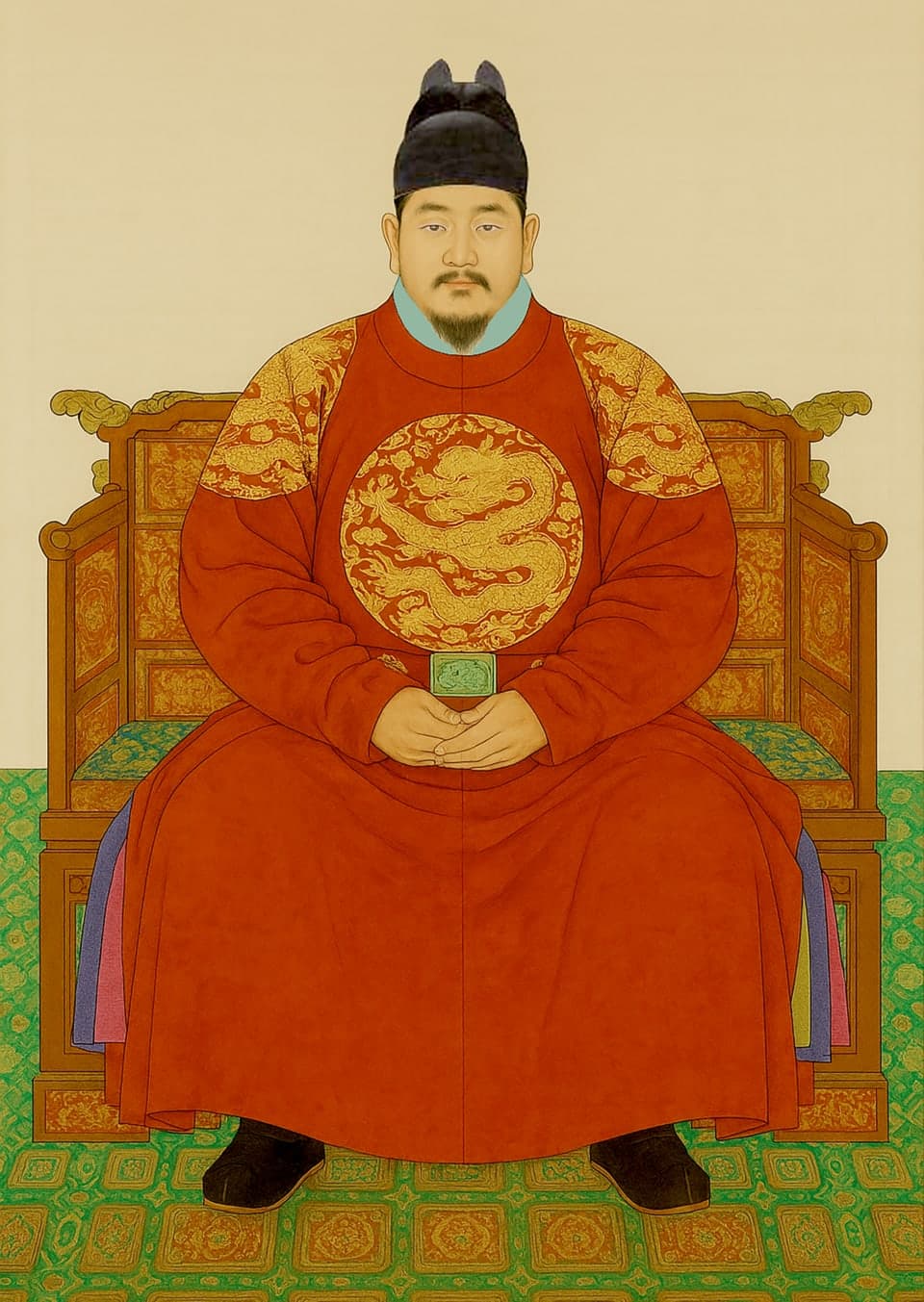
That is by design. 한글 (Hangeul) is one of the few writing systems that was planned rather than inherited. King Sejong commissioned it in 1443 so ordinary people could read without years of schooling, and it still does that job. It only takes 90 minutes.
All 40 letters are taught here, broken up into seven groups. Every letter has a mnemonic and native audio, and a typing quiz after each group makes them stick. You type with your own keyboard in the browser: nothing to install, no account. You will read 서울 by the third group, and words you did not know you knew by the end.
It's an alphabet, not thousands of characters
Korean uses an alphabet: 24 basic letters, 14 consonants and 10 vowels. The other 16 are those same pieces recombined. Some people postpone learning Hangeul expecting Chinese-scale memorisation, when the whole writing system takes an afternoon to learn.
It is also consistent in a way English is not. Consonants are diagrams of the mouth making each sound, vowels come from three strokes, and spelling tracks pronunciation closely.
ㄴ is the tongue with its tip raised behind the teeth, where it sits for “n”. ㅁ is a square: a closed mouth, for “m”. These are not mnemonics invented afterwards. Sejong's scholars drew the letters from the shapes your mouth makes.
ㄱ
g / k
back of the tongue rises
ㄴ
n
tongue tip behind the teeth
ㅁ
m
lips close
ㅅ
s
air hisses past the teeth
ㅇ
ng
open throat
Its authors claimed a clever person could learn it in a morning and a slow one in ten days, and that's still the case.
Where Hangeul came from
Most writing systems grew organically over centuries, borrowing symbols and keeping historical quirks that don't fit the language. English spelling is a prime example: full of rules and exceptions that nobody would design on purpose.
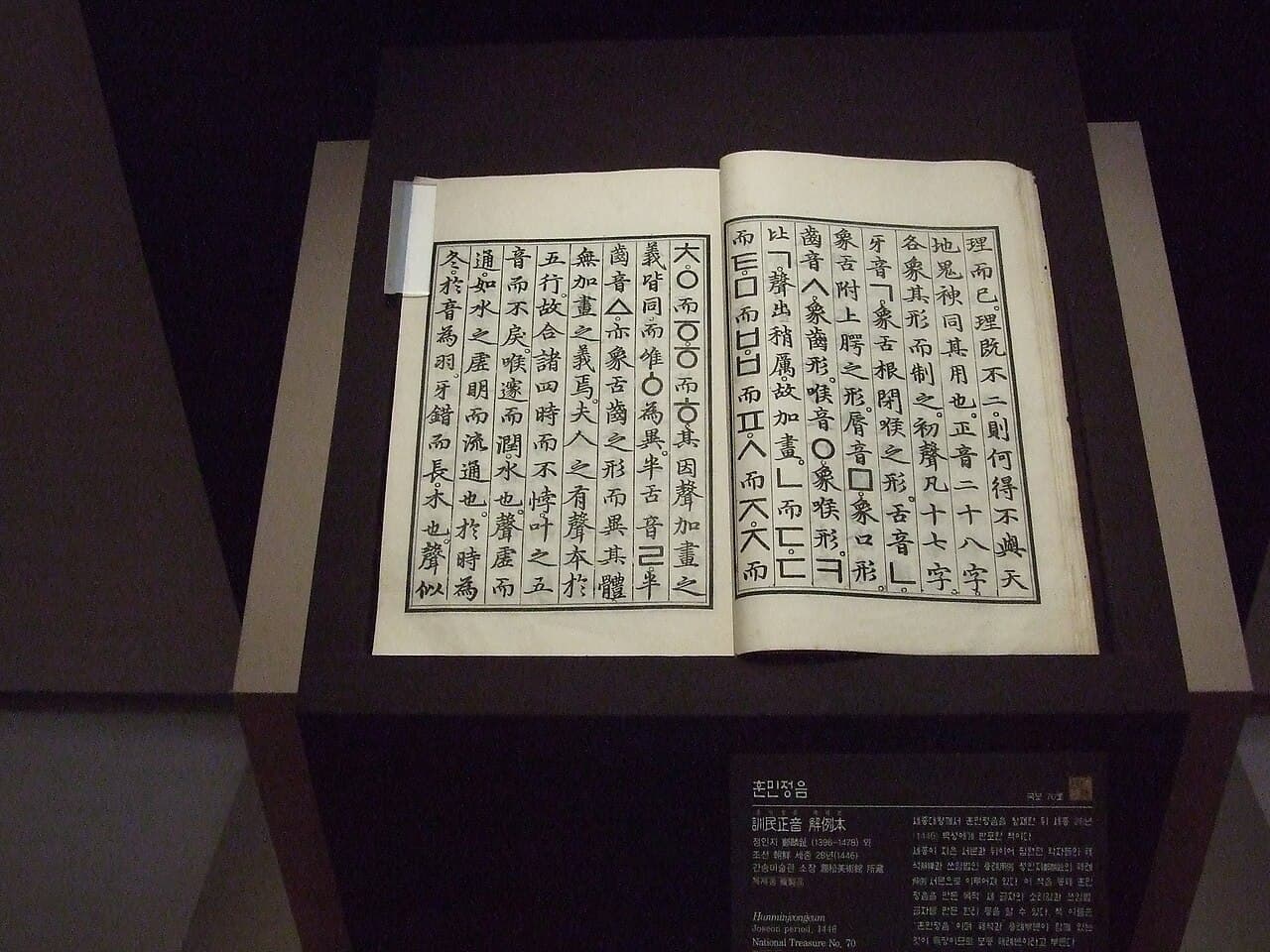
In contrast, Hangeul was designed. In 1443 King Sejong set out to fix a specific problem: reading Korean required years of training in Chinese characters, which kept literacy inside the aristocracy. He and his scholars built an alphabet from first principles, shaping each letter after the mouth position that produces its sound. They published it in 1446 as the 훈민정음, the correct sounds for the instruction of the people.
The document says so outright. It opens by noting that Korean speech differs from Chinese, so ordinary people who wanted to write had no way to express themselves, and states that Sejong made the 28 letters out of pity for them. This document was the start of a truly unique writing system, one that is a source of Korean national pride to this day.
How letters form syllable blocks
Korean letters group into square blocks, one per syllable, rather than running along a single axis. 한국 (Korea) is six letters, ㅎ ㅏ ㄴ ㄱ ㅜ ㄱ, stacked into two blocks: 한 and 국. That is the only layout rule.
Every block is a consonant, then a vowel, then an optional final consonant underneath. That bottom slot is the batchim, which a lot of Korean grammar makes use of. There are two shapes:
One rule to take early: a vowel cannot fill a block alone. When a syllable starts with a vowel sound, the circle ㅇ sits in the consonant slot and stays silent, holding the space. So “ah” is 아, silent ㅇ first, vowel after.
Build a few blocks yourself:
1 · Consonant
2 · Vowel
3 · Batchim (optional)
한
You'll be typing these, not handwriting them
You will type Korean far more than you write it, so this guide uses the keyboard rather than a worksheet. The standard layout splits by type: consonants on the left half, vowels on the right. That makes it faster to learn than it looks.
Every letter card shows its key, and every quiz takes your own keyboard or the on-screen one. The layout should feel familiar by the end of the page.
The 두벌식 layout, Korea's standard. Consonants left, vowels right.
Six basic vowels first. Play each one as you read it, starting with 아:
The six basic vowels
Every vowel comes from three strokes: a horizontal line (earth), a vertical line (a standing person), and a short mark that began as a dot (the sun). Combine them and you have the first six. ㅏ puts the mark right of the vertical line for “ah”; ㅓ puts it left for “uh”. ㅗ puts it above the horizontal line for “oh”, ㅜ below for “oo”. The last two are the bare strokes: ㅡ flat, ㅣ upright.
Play the audio on each card, then use the quiz to check they stuck.
aah, as in father
A person standing tall (the vertical line) with an arm pointing out to the bright east: open your mouth and say "ah".
eouh, as in up
The same person, arm pointing west. The sound turns inward too, a darker "uh".
ooh, as in go
A sprout growing up out of the ground line: "oh", round and upward.
uoo, as in moon
A root hanging down under the ground: "oo", low and deep.
eua flat "uh" with lips spread, no English twin
The ground itself: one flat line. Spread your lips just as flat and push the sound through.
iee, as in see
A person standing at attention: tall, thin, "ee".
Checkpoint 1 · 6 letters so far
Which sound is this letter?
ㅏ
Your first five consonants
The consonants are where the mouth diagrams pay off. ㄴ is the tongue tip raised behind the teeth for “n”. ㄱ is the back of the tongue rising toward the throat for “g”. ㅁ is a closed mouth for “m”. Say each slowly and you can feel your mouth making the letter.
Two need a note. ㄱ sits between English g and k, softer than either. ㄹ is a single light tap between r and l: do not pick a side, copy the audio.
gg, between g and k, as in go기역
A side-view diagram of your tongue, its root kinking up at the throat, which is exactly where "g" happens.
nn, as in no니은
Your tongue tip curling up to touch behind your teeth. Say "n" and feel it land exactly there.
dd, between d and t, as in do디귿
ㄴ with a roof on it: same tongue position, but now the air gets stopped, "d".
ra quick tap between r and l리을
The tongue caught mid-flick. It isn't r and it isn't l, it's one fast tap that lives between them.
mm, as in mom미음
A closed mouth, drawn as a box. Close yours the same way: "m". The most honest letter ever designed.
Checkpoint 2 · 11 letters so far
Which sound is this letter?
ㄱ
The rest of the basics
Five more consonants finish the basics. ㅅ is a tooth shape for “s”. ㅂ builds on ㅁ for “b”, ㅈ builds on ㅅ for “j”. Later letters keep doing this: take a shape you know, add a mark.
ㅇ does two jobs depending on position. At the start of a block it is silent, the placeholder from earlier. At the bottom it is “ng”, as in “ring”.
That bottom slot is the batchim (받침, “support”). Any block can take one: 하 is “ha”, and ㄴ underneath makes 한, “han”. From here the quizzes ask for whole words, not single letters.
bb, between b and p, as in boy비읍
ㅁ with steam rising out of the top, the closed mouth pops open: "b".
ss, as in sun (sh before ㅣ)시옷
A tooth. Air hisses past it: "s".
jj, as in jump지읒
ㅅ wearing a lid. The hiss gets trapped and comes out as "j".
hh, as in hat히읗
ㅇ in a hat, breathing out: "h".
ngsilent at the start; ng, as in ring, at the bottom이응
A zero, and it acts like one: silent up top, just holding the seat for a vowel. Parked at the bottom of a block it hums "ng".
Checkpoint 3 · 16 letters so far
Which sound is this letter?
ㅅ
The aspirated four
These four are variations on consonants you know. Take ㄱ, ㄷ, ㅂ and ㅈ, add one stroke, and you get the aspirated version, said with a puff of air. ㄱ (“g”) becomes ㅋ (“k”). Hold a palm in front of your mouth: “k” pushes noticeably more air than “g”.
kk, as in kite키읔
ㄱ plus one stroke = ㄱ plus one puff of air. Hold your palm in front of your mouth and feel the difference.
tt, as in top티읕
ㄷ with an extra line: same tongue, more air, "t".
pp, as in pie피읖
ㅂ redrawn with air vents. The air escapes: "p".
chch, as in chair치읓
ㅈ with a spark on top: "ch".
Checkpoint 4 · 20 letters so far
Which sound is this letter?
ㅋ
The tense doubles
These five go the other way: not more air, but a tighter sound. Write the base consonant twice, so ㄱ becomes ㄲ, and say it tense and clipped, closer to the k in “sky” than “kite”. Same keyboard keys as the single consonants, with Shift.
The difference carries meaning: 방 is “room”, 빵 is “bread”. Listen:
kka tight, airless k쌍기역
Two ㄱs shoulder to shoulder. Squeeze your throat and release nothing, "kk".
tta clipped, tense t쌍디귿
Double ㄷ, clipped and tight, with no puff at all.
pplips pressed hard, then popped쌍비읍
Double ㅂ, press your lips hard and pop them. The word for bread depends on this letter.
ssa sharp, hissy s쌍시옷
Double ㅅ, the hiss, sharpened.
jja tense, tight j쌍지읒
Double ㅈ, "jj", tight as a drum.
Checkpoint 5 · 25 letters so far
Which sound is this letter?
ㄲ
Y-vowels and the eh twins
Vowels work the same way. A second short stroke puts a “y” on the front: ㅏ (“ah”) becomes ㅑ (“yah”), ㅗ (“oh”) becomes ㅛ (“yo”). Four letters, almost nothing new to remember.
ㅐ and ㅔ are the exception. Both are “eh” as in “bed”, and in modern Korean they sound identical. Native speakers pause over which one a word takes, the way English writers pause over “their” and “there”. Learn both shapes; the spellings come with exposure.
yaya, as in yard
ㅏ with a second branch. The extra twig adds a y-: "ya".
yeoyuh, as in young
ㅓ doubled the same way: "yuh".
yoyo, as in yogurt
ㅗ with a second sprout: "yo".
yuyou
ㅜ with a second root: "yu".
aeeh, as in bed
ㅏ leaning against ㅣ: "eh".
eeh, as in bed (same as ㅐ)
ㅓ leaning against ㅣ, and yes, it sounds identical to ㅐ today. Spelling is the only referee.
yaeyeh
ㅑ + ㅣ: "yeh". Rare, it mostly lives inside 얘기.
yeyeh, as in 예 (yes)
ㅕ + ㅣ: "yeh", the polite yes you'll hear constantly.
Checkpoint 6 · 33 letters so far
Which sound is this letter?
ㅑ
Compound vowels
The last seven look worst and are easiest: each is two vowels you know, combined in one block. ㅗ + ㅏ makes ㅘ. Say “oh” and “ah” quickly and you get “wah”. Read them as their parts, and type the parts in order: the block assembles itself.
Two exceptions. ㅚ looks like “o” plus “i” but is said “weh”, which you memorise. ㅢ (“uh-ee” in one beat) has no single rule: Koreans say it several ways depending on the word. Do not chase it.
wawah
ㅗ then ㅏ, said fast: "o"+"a" fuses into "wa". Read the parts, don't memorize a new shape.
waeweh
ㅗ + ㅐ: "weh", as in 왜, the word for "why".
oeweh (despite its looks)
ㅗ + ㅣ, looks like "oi", sounds like "weh". The one genuine exception; memorize it and move on.
wowuh
ㅜ + ㅓ: "wuh", as in 원, the money in your pocket in Seoul.
weweh
ㅜ + ㅔ: "weh". Rare, mostly imported words like 웨딩.
wiwee
ㅜ + ㅣ: "wee".
uiuh-ee, said in one beat
ㅡ + ㅣ in one beat: "uh-ee". The famously slippery one, even textbooks argue about it.
Checkpoint 7 · 40 letters so far
Which sound is this letter?
ㅘ
A shortcut: English loanwords
That is all 40 letters. Korean borrows heavily from English and spells it in Hangeul, so a chunk of your reading is already done. Sound these out before you check the translation:
아이스크림
a-i-seu-keu-rim: ice cream
커피
keo-pi: coffee
콜라
kol-la: cola
피자
pi-ja: pizza
컴퓨터
keom-pyu-teo: computer
If those came easily you have crossed from decoding letter by letter into reading. The final quiz mixes every letter and word in the guide.
Final exam · all 40 letters
Which sound is this letter?
ㅎ
Making the letters stick
Recognizing the letters is just the start. Real speed, along with the sound-change rules that come later, arrives when you meet the letters inside real words on a regular schedule. That's exactly what HanGeul is built for: a typing-first course that starts with these same 40 letters and grows to over 5,000 words, showing you the exact letter you got wrong whenever you miss. The first three levels are completely free.
Frequently asked questions
- How long does it take to learn the Korean alphabet?
- About 90 minutes to read all 40 letters if you practice as you go, which is exactly how this guide paces you. True reading fluency, where words stop feeling like puzzles, usually takes a couple of weeks of short daily practice on real vocabulary.
- How many letters does the Korean alphabet have?
- 24 basic letters: 14 consonants and 10 vowels. Another 16 are combinations of those (5 doubled consonants and 11 compound vowels), bringing the total to 40. Every one of them is built from the same small set of reusable strokes.
- Is Korean written with Chinese characters?
- No. Modern Korean is written entirely in Hangeul, the alphabet King Sejong's court created in 1443. Chinese characters (hanja) survive only in the occasional newspaper headline, legal document, or name card, and you can read Korea today without knowing a single one.
- Is it "Hangul" or "Hangeul"?
- Both spell the same word: 한글, the name of the Korean alphabet. "Hangeul" is the official Revised Romanization used in South Korea; "Hangul" is the older McCune-Reischauer form that stuck in English. Use either. Koreans write 한글.
- Should I learn romanization first?
- No, you can safely skip it. Romanization tends to mislead more than it helps, because the same Korean sound gets spelled three different ways in the wild, and every hour spent reading "annyeonghaseyo" is an hour not spent reading 안녕하세요. Learn the 40 letters once and they'll serve you for years.
- What's the difference between 한글 and 한국어?
- 한글 (Hangeul) is the alphabet, the writing system itself. 한국어 (Hangugeo) is the Korean language. This page teaches you 한글; the words, grammar, and everything after are 한국어.